Up one level
Back to Home
  Information and Modifications for the MSR-2000 station
Compiled by Mike Morris WA6ILQ


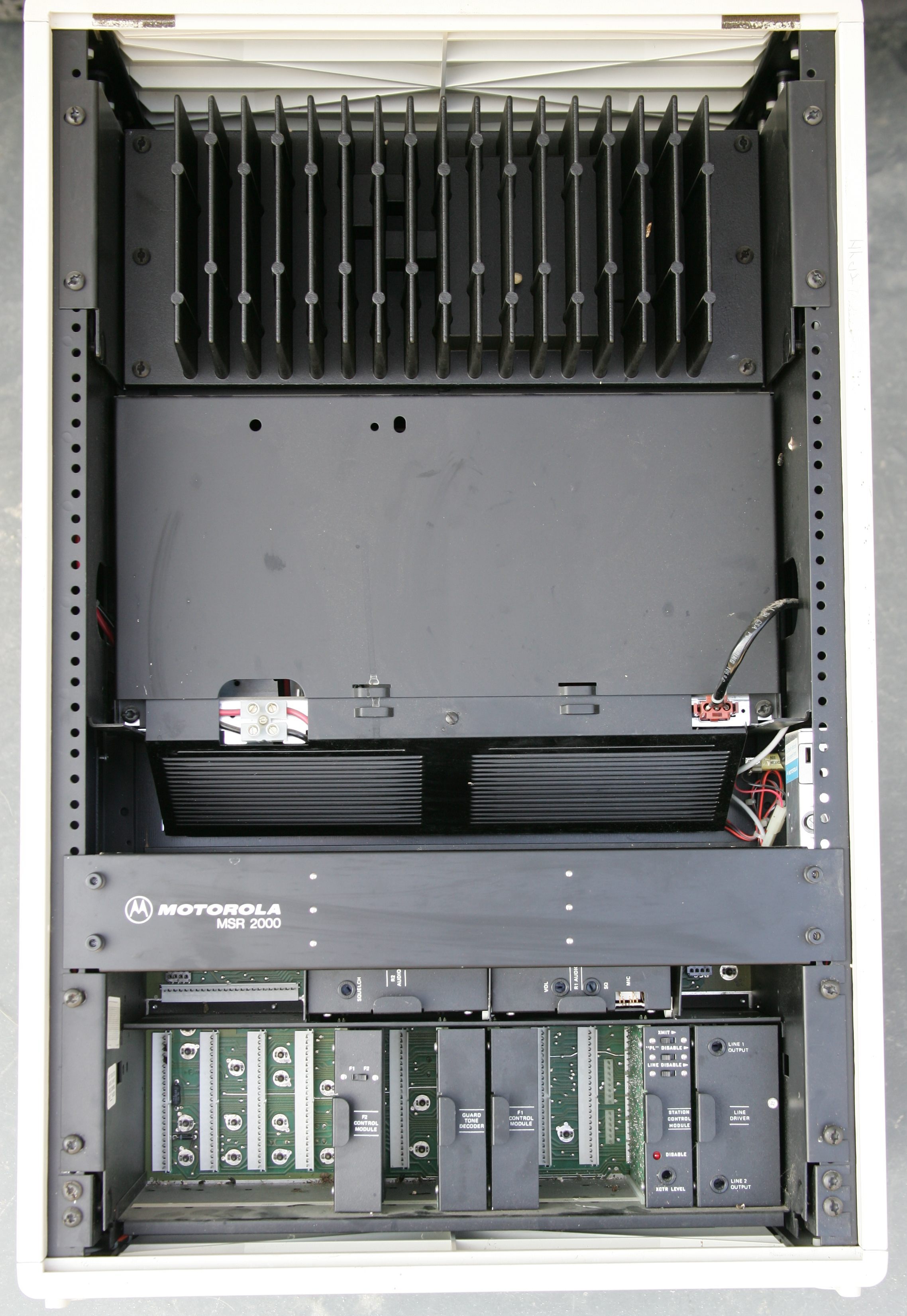
A dual receiver wireline controlled MSR2000 continuous duty station
The exciter and receiver card(s) are behind the panel above the horizontal cards.
The empty horizontal slot at the top left is for the "coded squelch" card (either PL or DPL).
Click on the image above for a larger image (576KB).   Photos by Tim Ahrens W5FN


A view of the exciter and receiver card(s). From the left is the exciter, the second receiver and the primary receiver.
Most MSRs will not have the second receiver.
Click on the image above for a larger image (457KB).   Photos by Tim Ahrens W5FN


The MSR2000 is a base or repeater station that was a follow-on to the Micor line, and was available only in VHF and UHF. It is basically a second-generation Micor station control shelf mated to the receiver and exciter sections of a Mitrek mobile, mated to a Micor-derived PA deck.   The station shelf has a few upgrades (like the horizontal slots at the top, and a new, more reliable style of card-to-backplane connector), and the RF sections are separate receiver and exciter sections. The control card cage is almost identical to a Micor and most of the notes on the Micor station control shelf are applicable. If you replace the card edge connectors that mate with the Micor backplane with ones made for the MSR you can use several of the Micor cards in the MSR card cage - BUT NOT ALL.   Compare the pinout before you go to the trouble of changing the connectors.

The MSR2000 is a non-synthesized station, and uses receiver and exciter modules that are derived from the Mitrek mobile radio.   The frequency-determining component is a self-contained oscillator-tripler plug-in module called a Channel Element.   When you move an MSR from one channel to another it requires cutting a new crystal for the receiver and a second for the transmitter.   This article is worth reading: Why should you really spend $50 to re-crystal a channel element.

A list of the various channel elements used in the MSR station and the Mitrek mobile is here: Channel elements for the Mitrek and MSR2000.

The documentation for the MSR station consists of two separate manuals: an RF manual (that is frequency band dependent) and a "Control and Audio" manual, a full list is below.   At the time of this writing (mid 2009) the RF manuals were out of stock (but are PDF'd below) and the "Control and Audio" manual was still available for US$55-$60.   If you have a UHF station you will need to print the power supply and accessory section from the high band PDFs below, or locate a VHF book just for the power supply and accessories.   Click here for instructions on how to order manuals.

As far as I can tell from the manuals, the model number on the USA-built MSR2000s breaks down as:

Sample model number: C74GSB-3106BTX    Numbers in [ ] refer to notes below.
C 7 4 G S B
Cabinet
Type [1]
Power
Level
Frequency
Band [2]
Duty
Cycle [3]
Configuration [4] Supply
Voltage [5]
B
Base
Station
Cabinet
5
40-70 watts
3
VHF
G
Intermittent
R
Base Station
(no duplex shield kit,
has the base station backplane)
A
+12vDC
C
Compact
Cabinet
6
70-90 watts
4
UHF
K
Continuous
S
Repeater
(has the duplex shield kit
and duplex backplane)
B
120vAC
N
No
Cabinet
7
90-120 watts
K
120v or 240vAC

Sample model number: C74GSB-3106BTX    Numbers in [ ] refer to notes below.
3 1 0 6 B T X
Squelch
Type [6]
Channel
Deviation [7]
Frequencies [8] Control [9] Version Configuration [10] (?) [11]
1
Carrier
0
15 KHz
0
Single Frequency
3
Local Only
A A
(?)
X
(?)
3
PL
1
5 KHz
3
Two Frequency
5
DC Wireline
B B
Base
6
DPL
9
Four Frequency
6
Tone Wireline
C D
(?)
7
(?)
D T
Repeater
Table Notes:

  1. An "N" is a very rare beast, as they were special order. It was actually cheaper (and quicker) to order a "C" and remove it from the cabinet (which could be sold to someone else).
  2. The frequency range (the "split") is not encoded into the model number. To determine if you have a (for example) 132-150 or a 146-174 MHz station you will need to look at the part number of a frequency determining part, like the exciter, receiver, or PA deck.   A table of all of the exciters and the receivers that I know of is below.
  3. There is no practical way to change an intermittent duty cycle radio to a continuous short of replacing the power supply and the PA deck.
  4. The MSR manual refers to the GS models as the "Fully Optionable" models. There is no practical way to convert a base to a repeater with full performance as the repeat duplex kit includes a different backplane, a different receiver, a different exciter and a different PA deck, plus some additional metal shield plates. Yes, the MSR-2000 Base can be converted for duplex repeat operation, it's just that something designed and built to run full duplex from the factory is better. It's much easier if you have the duplex (repeater) backplane, which is the one with the PL and R1-Audio Modules laying horizontal above the main module slots. And there were repeater, one-receiver and two-receiver backplanes. Only the factory repeaters were shipped with the duplex backplanes.
  5. The "A" power supply was basically a 120v AC supply minus the power transformer and bridge rectifier - just a DC filter and a 9.6 regulator. The "K" power supply was made in Canada and was extremely rare in the USA. I've only seen one of them.
  6. Changing squelch types involves changing out the squelch card (or adding one if you have a carrier squelch station). The TRN5073 is the duplex PL board, the TRN5074 is the simplex PL board (and the TRN5076 is the duplex DPL board, the TRN5077 is the simplex DPL board, and there is an article on this web site on how to make your own TRN6005 DPL code plugs).
  7. A "0" is a very rare beast as the market for wideband radios is very limited. It was a special order for the broadcast industry as some stations still had VHF and UHF remote pickup channels at the time these stations were current products.
  8. The base station (simplex) exciters and recivers were all built for four frequency operation, the difference in the station was the number of channel elements that were included and the complement of the cards in the control shelf.
  9. I've seen one "7" unit, and could not figure out what the difference was. If anybody has any information on it I'd appreciate it.
  10. Does anybody have any information on the "A" or "D" configurations?
  11. The manual does not explain the "X", and I've seen two MSRs that had the "X" at the end of the model number and could not figure out what the difference was. Can anyone shed some light on the topic?

The Model Tables, Option Tables and Specifications from the 6881061E50-C VHF manual   1.7 MB PDF file
From these tables you can fully decode the cabinet model number and figure out what your station was shipped with.

Station Notes

So if you are looking for a used MSR the ideal radio is a xnnKSB-31xxBT, CT or DT series (where "x" is the appropriate letter and "n" is the appropriate number), and a GSB series will do just fine at reduced power and a with a fan.   And if you end up with a GSB series you really want to mount a second (backup) fan controlled by a thermostat.

Useful MSR-2000 Manuals, etc.       Click here for instructions on how to order manuals

Prices quoted below are Moto "NSO" Pricing ("National Service Organization") - the prices that Moto charges their service shops. Pricing to the public may be higher. Prices are changed quarterly, so use the mentioned prices only as indicators.

The following sections from the MSR2000 VHF Service Manual (6881061E50) were scanned and submitted to Repeater-Builder anonymously. Click on each one to download it.

The following sections from the MSR2000 UHF Service Manual (6881061E55) were scanned and submitted to Repeater-Builder anonymously. Click on each one to download it.

Articles:

.Alignment of the MSR-2000 station UHF receiver   176kb PDF document

.Alignment of the MSR-2000 station UHF transmitter
  1.2mb PDF document

.Conversion of an MSR-2000 station to an amateur repeater    By Henry Wingate K4HAL

.A status display for the MSR-2000 station     By Henry Wingate K4HAL 

. MSR-2000 test set (TRN5079 and TRN5080) - Photo   Schematic and parts list   courtesy of David Stanford K7IOU

.Another conversion of an MSR-2000 station to an amateur repeater   By David Stanford K7IOU   (offsite link)

.Conversion of an MSR-2000 station for the WØDOD repeater   By Nate Bargmann, NØNB

.There is one interfacing technique that we don't have an article on... it was described to me over dinner a few years ago...
Take a card like a timeout timer card, strip it, mount an RLC-MOT (and optionally a PL tone decoder) on standoffs, then mount a DB15 into the front sheet metal. Slide that interface card into the squelch gate slot. Use the DB15 to connect the repeat audio, COR and PL decode signals to an external controller. The same card can inject repeat audio from the controller into the backplane.
The controller interface card hadles the repeater in normal use, then if the outside controller takes a dive you can unplug this interface board and plug a regular (unmodified) squelch gate card in to get the system back on the air. Using a squelch gate card does not provide an identifier, but does give you a good emergency kerchunk box (a very basic repeater). The different sounding squelch tail and different carrier delay timer duration will tell your users that the backup "control" system is in place and that they need to voice ID the system.

.Modifications to the MSR-2000 cards by VE6SBS for the VE6NHB repeater     Original article, offsite link
I suggest you read the entire article first.

Here are the schematics of his modified MSR-2000 card cage and cards: (all are pdf files)
The modifications on the schematics are not visible - the modified prints look just like original Moto schematics - you will have to compare them to the originals to determine the changes.
      .Backplane wiring   5.1mb
      .TLD9232 exciter   555kb
      .TRD6182 receiver   618kb
      .TRN5069A R1 Audio Squelch   442kb
      .TRN5075A PL encoder decoder   423kb
      .TRN5321A Station Control   343kb
      .TRN5331B Squelch Gate   509kb

. Documentation on the TLN6721CDX TX Alarm card - provided by A. Nony Mous (see Documentation page for photos of the card)
This card was designed for the Canadian Provincial Police system of over 600 MSRs that was decomissioned about 2002. These were a mix of continuous and intermittent duty 136-150 MHz stations that were deployed in shelters that had battery backup and local AC generators, and an adjacent radio tower, with all of the sites linked by microwave shots. The relay contacts on this card were integrated into the site alarm system. There is a downloadable 4-page PDF containing a theory writeup and schematic linked to this page.

. Documentation on the QLN2812A Station Identifier Field Modification Kit - provided by John Gilbert KA4JMC
This kit was made up of a QRN8424B or QRN8425B module, the QKN7547A cable, this documentation and a few other loose pieces.
The QRN8424B is used in Micor stations, the QRN8425B module is used in MSR2000 stations.
This module uses a fairly inflexible design - the IDer audio frequency (1,200 Hz) is slaved to the IDer morse code speed. The IDer spacing is either 15 or 30 minutes (but is dependent on the timing of a 555 chip). Both of these modules use a 256x4 PROM chip that is almost pure unobtanium (Monolithic Memories MM5301-1). Each byte represents one time frame, a dit requires two frames, a dah requires four, a word space requires five. Module overhead uses 31 frames. The rest can be used for the actual IDer string (the Morse code sequence). An adapter could be made to allow use of a 27nn or 27nnn series chip, but it's much easier to use an external repeater controller like an NHRC, Scom, etc., but since FCC Rules require you to be able to remotely switch the repeater on and off you need a real repeater controller anyway... and you can buy a decent one for under US$160 (the NHRC-4)

. Documentation on the TLN640CDX IDer card - provided by www.radiowrench.com       Photo of the card
If you have an MSR that uses this IDer it's MUCH easier and more flexible to ignore / remove this card and use an external repeater controller like an NHRC, Scom, etc. as this card uses an almost-impossible-to-get 32x8 one-time-burnable PROM chip (yes, 256 bits), plus almost nobody can burn them any more. Yes, you could build a socket adapter and plug in a more modern 27nn or 27nnn series PROM chip, but since FCC Rules require you to be able to remotely switch the repeater on and off you need a real repeater controller anyway... and you can buy a decent one for under US$160 (the NHRC-4)
       Cover page (info on the donor)     Pg1 440kb     Pg2 51.4kb     Pg3 43.4kb     Pg4 93.8kb     Pg5 33kb
       Pg6 55kb (programming chart)     Pg7 40.5kb (parts list)     Pg8 1.32mb (schematic right half)     Pg9 1.25mb (schematic left half)
       Pg10 1.35mb (PCB layout pg1)     Pg11 1.4mb (PCB layout pg2)        All of the pdfs in one zip file for easy downloading

. If you absolutely have to put a card-based IDer into an MSR shelf you basically have three options:
1) Mount a mini-repeater-controller like an NHRC-4 or a ICS Basic on a stripped Time Out Timer card and plug it into the Squelch Gate card position, or
2) Go read the "An IDer for the MICOR Repeater Shelf" article located on the Micor page at this web site (but you'll find that the ID-8 module is rather expensive) then build it on a stripped down line driver card as shown, or
3) Purchase an ID-O-Matic kit (for about US$20) from NØXAS (at http://www.hamgadgets.com), build it, mount it on a stripped-down Time Out Timer card, and patch it transmitter audio in the shelf as shown in the Micor IDer article. All you need to do to make the ID-O-Matic module work is to hook up power, ground, COR, PTT and audio out, then program it.

. Documentation of the various jumpers throughout the station - provided by George Henry KA3HSW
Includes the backplane and the various plug-in boards. Compiled from several MSR2000 manuals.

. More photos from Tim Ahrens W5FN:
TLD9232BPR Exciter           TRD6302APR Receiver


Back to the top of the page
Up one level
Back to Home


This page was created August 1, 2009 by splitting the MSR2000 information off of the Mitrek index page.

Artistic layout and hand-coded HTML © Copyright 2005 and date of last update by Mike Morris WA6ILQ.

Motorola® is a registered trademark of Motorola Inc.     Image used with permission.
Channel Element, Mitrek® and MSR-2000® are registered trademarks of Motorola Inc.   So there!

This web page, this web site, the information presented in and on its pages and in these modifications and conversions is © Copyrighted 1995 and (date of last update) by Kevin Custer W3KKC and multiple originating authors.   All Rights Reserved, including that of paper and web publication elsewhere.